
FAA Heliport & Helipad Design Guide (AC 150/5390-2D)
The FAA Advisory Circular 150/5390-2D serves as the principal design guidance for civilian heliports in the United States. It covers planning, layout, safety areas, approach and departure paths, markings, lighting, pavement, and operational considerations for General Aviation, Transport, and Hospital heliports. This guide summarizes the document in a format that is easier to understand.
A plain-English overview of the FAA’s primary guidance for heliport planning, design, and construction.
Why This Guide Matters
Designing a heliport involves considerably more than selecting a flat area for helicopter landings. Safe heliport design requires careful consideration of helicopter performance, obstacle clearance, pavement design, lighting, markings, environmental impacts, and future needs. Whether planning a hospital rooftop heliport, a private corporate facility, or a public-use heliport, understanding FAA guidance early in the planning process can reduce redesign costs, improve operational safety, and simplify any coordination.
Three Types of Heliports
The FAA categorizes heliports into three primary categories:
General Aviation Heliports
Typically serve privately owned helicopters, flight schools, tourism, law enforcement, and business aviation.
Transport Heliports
Designed for larger helicopters carrying passengers or cargo and intended for more demanding operations.
Hospital Heliports
Designed specifically to support emergency medical transport and rapid patient transfer while considering hospital access and surrounding infrastructure
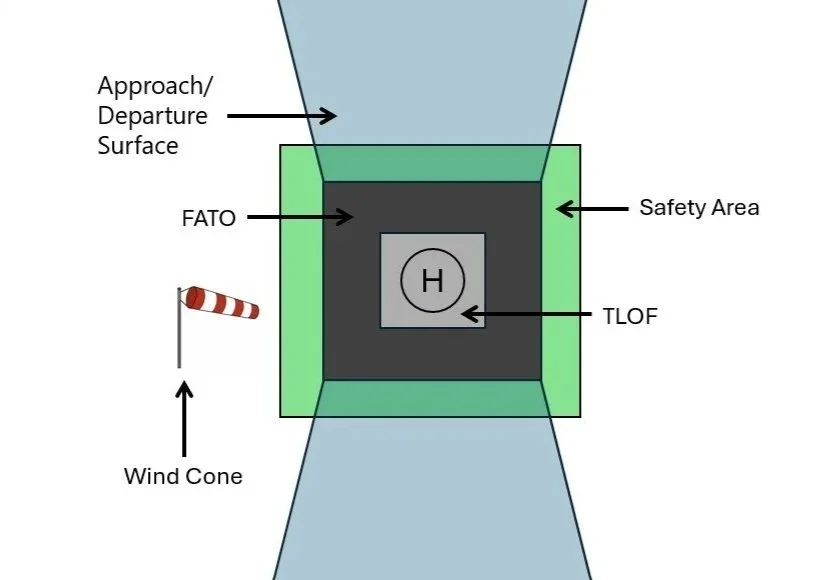
The Five Fundamental Components of Every Heliport
Touchdown and Liftoff Area (TLOF)
The TLOF is the designated load-bearing area where a helicopter lands and takes off. Think of it as the helicopter’s “parking spot”. The TLOF must be designed to support the design of the helicopter while providing a stable landing surface
Final Approach and Takeoff Area (FATO)
The FATO surrounds or contains the TLOF and provides the protected area associated with helicopter approach and departure operations. A helicopter normally completes its landings within the TLOF, while the FATO provides additional operational protection during arrival and departure.
Safety Area
The Safety Area surrounds the FATO and provides an additional buffer that helps reduce risk if a helicopter deviates from its intended landing or departure path.
Wind Cone
A wind cone provides pilots with a visual indication of wind direction and approximate wind speed before landing or departure. Its location should maximize visibility while remaining outside protected safety areas.
Approach and Departure Surfaces
These protected airspace corridors help ensure helicopters can safely arrive and depart without conflicts with terrain or obstacles. Their orientation should consider prevailing winds, nearby development, and operational requirements.
Frequently Asked Questions
-
The FAA describes AC 150/5390-2D as guidance for planning, design, and construction. It is generally advisory rather than regulatory, although it becomes mandatory in certain federally funded or otherwise specified contexts described in the circular.
-
Yes. The Advisory Circular includes guidance specific to rooftop and elevated heliports, including structural considerations, safety nets, access, and obstacle protection.
-
Yes. The Advisory Circular contains dimensional tables and design criteria that vary depending on heliport type and helicopter characteristics.
Need Assistance?
Planning a heliport involves more than meeting dimensional requirements. If your organization is evaluating a new heliport or modifying an existing facility, Von Aero provides technical consulting focused on site evaluation, regulatory guidance, and design support.
References
Federal Aviation Administration (FAA). AC 150/5390-2D: Heliport Design. January 5, 2023